Friday, November 6, 2009

Short-term Memory Loss and Recovery


Wow! Part of the beauty of a blog is the dynamic, day-to-day ability to post new information, or to correct mistakes! I had forgotten since March that a 3rd bag can be taken on the airlines, for $100 extra. I am over 50 now, and boy, it shows in the short-term memory lapses. I use a small notebook, every day, as my portable memory of things to remember!
So, corrections to the Algebra Problem:
Wendy Can take three bags, #300 pounds, of stuff, as long as the extra $100 is available as well. I can't even compute the cubic inches-- let's not try!
Other tweaks to the wish list:
USED SCRUBS: The students were issued 1 set of scrubs, to wear when they are training at the hospital. They would greatly appreciate an extra set, each. Since laundry is done by hand in a washtub in one's back yard, and hung to dry on cactus bushes, the value of spare scrubs becomes obvious. See photos of students in scrubs, and of laundry being done in the alleyway. (These photos look much better when you click on them & enlarge them).
A Laptop computer is also needed for our new (second!) Haitian nurse-midiwfe teacher, if anyone has a "spare laptop"!.

Wednesday, November 4, 2009

Algebra Problem


Amazing friends, family and supporters, are now asking "What are the needs for the December trip to Haiti?" It's a tough answer, because I learned last time that, at best, I will be taking 2 maximum-size duffel bags, and one small carry-on. I pay an extra $100 each for each bag, each of which I pack to the 100 lbs capacity, and use my carry-on for my personal stuff. So it's like an algebra story probem: "Wendy can take #200 pounds of items to Haiti, packed into 6,750 cubic inches...items must be small, lightweight, and of high value to the Haitian mothers, midwives, and babies. What should she take?"

So here are the suggestions and wishlist so far. I also am trusting the astonishing power of concerned individuals to let their hearts lead them to the perfect act of kindness...over and over again, it happens, better than we can "plan" it.

*Financial donations are obviously the most liquid and portable of all. Checks written to "Midwives for Haiti" with "Dotson trip" in the memo line can be sent in through me, and used in multiple ways for needs as they arise.

* Medical supplies are coming in abundantly from salvage-concious nurses at both Prince William Hospital and Loudoun. Sterile, or ultra-clean, uncontaminated: gauze, gloves, cord clamps, suture, lidocaine, syringes, and suture.

* Baby supplies:
light receiving blankets
small soaps & shampoos
cloth diapers(nevermind the plastic pants-not used!)
Onesies of all sizes

*For the prenatal clinics:
Prenatal vitamins
Over the counter Iron supplements; ie, Slo-Fe,
Vitron -C

*For the students:
Lightweight White blouses, we could use 15-20 of them, varying sizes small-med-large, new or great condition
(The students wear a white blouse and dark skirt to class each day, getting an extra blouse would mean a lot to them.)
Gently Used Scrubs, various sizes
small pocket-size spiral notebooks
Baby doll and soft pelvis model, for teaching birth maneuvers(--any retired childbirth educators??)-could also be ordered from ChildbirthGraphics.com, Item # 53954, (costs $195).

For the orphanage where we will be staying:
Clean used children's shorts & t-shirts, dresses (It's always "summer" in Haiti!)
Small packages of crayons, chalk, small toys or school supplies.

Prayer. Any and all denominations and flavors! For our trip safety- health & security- wisdom. Success in our mission, that more mothers in the Central Plateau of Haiti will live to raise their families, through our help.

Thank You
Thank You
& Haiti thanks you

Sunday, October 25, 2009

May –November 2009: Living with the Kid in the Back -Seat


As important and compelling as it is, my volunteer work with Midwives for Haiti takes a back seat to my regular American life. I have a (wonderful and) demanding “real”job, with Loudoun Community Midwives, so M4H has been sitting in the back seat since May 2009. But WHAT a passenger she is! M4H is the backseat driver (or child) you love dearly and who will not shut up. Always hungry: How to help obtain funds for all the growth of the program in Haiti? Always questioning: When are you coming back? And always talking: Emails keep me connected to the folks down there that I care about—interpreter Theard got married, and I sent him a digital camera, because he asked. I have a “Creole Made Easy” CD (Easy- HA!) in my car, and have learned to say
“Jacques can give her the peanut butter”
“How do you feel?,
“First or Second Baby?”
“Do You Have Pain?” and
“PUSH” in Creole. And I can sing the Creole blessing for my food, too.

In spite of the tension it creates, I love it. Working to train midwives in Haiti gives me a different arena where I can feel my work accomplishes so much. So, in time I carve out of my “real”(USA) life and spend on the Haiti work, I’ve attended M4H planning meetings, and worked on editing the exams that our students take after completing each of their chapters in their textbook. I wrote a preliminary grant proposal to a large charitable foundation that may become a supporter. Haitian Artwork is on sale at the checkout window of my office. And now…I’m going back for another week in Haiti! I’m so excited.

This trip, December 4-12, has several goals. I’ll be teaching students about out-of-hospital birth techniques and some clinical skills. I hope to visit some of the M4H graduates and help ensure they have what they need to help mothers and babies. This trip, my 25-year old son, Stephen, will come along! Stephen volunteered to come and take film, then edit it for a video to use in the US, and maybe on YouTube, to educate others about Midwives for Haiti. We plan to interview a number of Haitian people involved with the work, film our students, teachers, and M4H projects, and just clearly portray life in Haiti, and why we do this work.

My hope is that the initial shock of going to a 3rd-World Country will be less intense the second time, giving me more energy to focus on the tasks at hand. I never want to become immune to feeling the pain or the burdens that others carry. I just hope the shock will be less crazy and stressful. I now know that many Haitian kids will holler “Blanc, Blanc! Gimme dollah!” whenever they see my white face. And I will just wave, rather than create a riot by actually giving away a dollar. I hope to not be too surprised to see pigeons pecking at the scraps on the kitchen floor, or when a bat goes flapping through the living room of the rectory at nightfall. (Note to self: Wear hat to dinner. Always sleep in bednet.) I know now that the first intense sight in Haiti is about a hundred Haitians screaming over a concrete barrier at the airport exit door, shouting to get taxi business. And I know who my ride is. I know where to get clean water, and what little gifts will make a Haitian smile. Being in Haiti is the gift, for me. I hope this upcoming trip will be worthwhile and sweet.

Monday, April 20, 2009

Haiti Hangover...or Afterglow?


I've been back from Haiti just over a month, now. I think my dear husband hoped, briefly, that I had made the trip, and gotten it out of my system. Alas, this is not the case. Actually, I'm planning a sale of Hatiian crafts and a public talk at my Quaker Meeting that helped sponsor the trip. God Bless Greg Dotson; he is a man that takes my passions to heart and helps nurture them to fruition. Greg's helped me with Haiti-P.R. and blog ideas, and he didn't even roll his eyes or sigh when I mentioned going back to Hinche in December. This man is a mid-husband, which is the animal midwives are meant to marry, but often don't. We often marry normal men, who mind very much that we are absent at all hours of the night and day and are consumed with caring for families other than our own. Those normal ones don't like the true midwife answer to "When will you be back?"....which is: "I don't know...When the baby's out and no one else is laboring." But I married a midhusband, 28 years ago. Thank God.

When I was in Haiti, I did not sleep well, and about 3 am on one of the nights, I woke up crying about...?.. it seemed like a definite disturbing thing at time, but now I just remember the deep need, the lack of resources... and the fact that the people kept going. The perseverance. But often, now, l wake up in America, and think about Haiti and the M4H program. I'm not weeping about it but neither can I let it go. What was once a set of abstract facts about a foreign Caribbean country now has faces, names, and real people attached. Once Haiti was a place I was going to work for a non-profit. Now, Haiti is a place where I have friends that need a lot of help. And I'm going back.

The Catholic Sisters of Charity (Mother Teresa's order) have an orphanage and feeding center, "Azil", in Hinche, and on Wednesday of our trip, we visited. Most kids there actually have families, but needed to be admitted and fed at the center to overcome malnutrition and regain health. The children get so excited when they see visitors arrive: not because we bring them things,( we do, but the things are quickly stored in a supply closet for later) , but they get excited because visitors hold them. I had children crowd around to sit on my lap, to be embraced. They did not ask for anything else. I could not even read to them, which I'd love to do, since I don't speak Creole. No, they just wanted to be touched and held. The intense human needs that I encountered in Haiti stay with me daily now...the need to eat enough; the need for clean water, need for health care and light to read with at night. The need for midwives to safely help women survive birth and live to raise their families. I have so much, in my comfortable life here, that I continually wonder what I can do to pass some of that to my Haitian friends.

I sent an email a few weeks after my return, to our interpreters Theard and Manno. I asked them to contact some craftsmen and women, and prepare items for purchase when the next group of midwives came from the US. So, when Sheila an Amy came to Hinche around Easter, "the guys" had located many soapstone statues, carved and painted wooden bowls, notecards, and embroidered clothes for us to buy in Hinche and sell in the US. The artists were so thankful to have big purchases! Then the items were wrapped and carried back to the US, through Port-au-Prince, to Miami, to Buffalo, and then to Leesburg in a car of one of Margie's relatives. The US part of the sale will be done when I speak about Midwives for Haiti at Goose Creek Friends Meeting on Mother's Day, May 10. Many of the items are beautiful. Some are strange or goofy. How to tell a person in Haiti, by email, what kind of shirt an American would buy? The collection of things is colorful and fun and lovely, and reminds me a lot of Hinche..The stuff is all over my dining room table....kind of like the piles of gauze and gloves and diapers right before I left. Fortunately, for all of us, we are a family that eats in the kitchen.

You are Cordially Invited to a Free Community Event & Charity Benefit

Wendy Dotson, CNM

will present

"Midwives for Haiti:
Saving the Lives of Mothers and Babies"

Sunday, May 10, 2009
Mother's Day
11:15 am

Goose Creek Friends Meetinghouse
18204 Lincoln Rd.
Purcellville, Va 20132

*
Public Talk & Slideshow
*
Haitian Handicrafts Sale
*
Scenic and Historic Grounds of Goose Creek Meeting open for picnicking

Thursday, March 19, 2009

Re-Entry


Getting off the plane in Miami, I stopped to use the ladies room before I got in the passport line. I was so distracted by washing my hands in a clean sink, with soap AND paper towels! all together!! that I walked away and forgot my bag of duty-free rum. I was admitted back in the US through the passport line, and into baggage claim, before I remembered. Eventually, a customs staff person did retrieve it for me.

My heart did a flip when I passed a barber shop in the Miami terminal. I could get my hair washed, NOW! In the twinkling of an eye and with a painless zip of a plastic credit card, I receved a manicure (goodbye, dirty fingernials!!) and a shampoo and trim of my hair. The hairdresser was Cuban and spoke mainly Spanish, but I explained I had been "doing doctor work in the mountains in Haiti" and did not have many showers. Afterwards she said "Yeah, I seen the dirt come out in the sink!!" It was such a relief to be clean. Cleaner, anyway. I had brought more from Haiti than I planned--- Haitian road dust, all the way from Hinche.

I had not eaten since peanut-butter-and-bread-breakfast that morning at Fr. Jacques' rectory, so I needed food. I found the elevator up to the main concourse, and then a directory of the shops. I stood in front of the glossy black map of the airport terminal, and glanced down the list of restaurant and food choices. And I started to cry. I looked over my shoulder at the folks in the terminal, a little embarrassed. I wanted to explain"...Sorry, you see, I've been in Haiti. And they do not have this much...this much food. Or this much choice. The leap between worlds is overwhelming." No one was bothered by my tears, however, so I wiped my eyes and found some lunch. My salad & 1/2 sandwich was served in a clear plastic box, and it was very hard to toss it away afterward. I thought: Someone in Haiti would use that box! And they would. But getting it back to Hinche would be tough. A lot of the poverty is linked to lack of transportation and roads. I hope Haiti can get better roads. I hope so many things for Haiti.

I hope that the Midwives for Haiti program will survive and grow , to become an established school that produces more and more trained practitioners that can save lives and reduce those catstrophic mortality rates. I hope that the many good people in the US know that one of their closest neighbors, in their own hemisphere, is one of the absolute poorest nations on earth. I hope the Haitians keep on trying. There is despair and anger in Haiti, but there are so many who keep doing their best, each day, not only to survive, but to succeed. There are people in Hinche, tonight, reading under every street light, working to learn and improve their lives. Danise is at home in the rectory, writing a qualifying exam to ensure that only the best, brightest students will be admitted to this program that she now teaches. She emailed and asked for a desk, so apparently she doesn't plan to leave soon. There are student midwives in a classroom, five days a week, learning how to care for women and babies with respect and kindness and skill. And Danise told me that every day, they pray for us, their friends in the U.S. And then they sing.

Sunday, March 15, 2009

A Haitian Birth-day, or ,The 3 S's


Dear Nadene and Steve,

As I fly home to Dulles, I want to thank you (??!) for the casual encouragement you gave me that "it would be great if I could take some student's over to L&D and deliver a baby in Haiti" before my week was out. Well, my friends, I did that, and what an experience it was! I tend to believe God has a plan in all situations, so I guess I was meant to grasp in huge experiential detail what it's like to lack what I will now call the "3 S's ": STUFF, trained STAFF, and STABLE surroundings (like water and electricity...) The language barrier added a special thrill as well!

So, I chose the 2 students who had no birth experiences except their own. On Friday pm at 2, they dressed nicely in their pink scrubs and followed me over the the Salle Maternite. I saw no one in the delivery area, so I introduced myself to the nurse at the maternity desk as one of the "Saj Famn pou Ayiti" midwives from the US, and said I would be happy if I could help with a delivery. Of course this was thru the interpreter, so I hope that's what I said. But perhaps this meant to her " I am WonderWoman!!- Bring it ON!"...I don't know.

The nurse said that "OK they got somebody for you" and they got a laboring lady out of bed and walked her across the hall to the delivery area for me to examine. She got up on the table, I found some gloves, and examined her. Her cervix was 6 cm dilated and she was having strong contractions. She was having her second baby. While I was explaining this to my students, I was slightly disconcerted that more women were being brought in and helped onto more tables--- they kept coming!

The next one was 5 cm dilated, fully effaced, 1st baby. OK...but here comes #3. She's only 3 cm, but making lots of noise and obviously laboring actively. I was starting to feel confused...do they just hang around those tables until they deliver? What about the labor area? And the nurse who was leading the stampede was doing almost nothing to organize or help me! ( I later learned she was the only nurse for ALL the maternity patients.. including rooms full of postpartum women, including some receiving blood. Aha.) NO STAFF. So I found a doppler and started checking fetal heart rate on everybody-- let's see if all the babies are OK! They were. Praise God. Next, I figured, OK, They've already invented Group Prenatal Care: let's try Group Labor! So while lady #4 was climbing onto her table, I did a round of Blood Pressures; this was hard because it was so loud in there with all the laboring and hollering. As far as I could tell, nobody was over 140/90. The nurse asked did I want to give the one with the 140/90 BP some Aldomet? Well, No thanks, I said, but could we dip her urine? We could, and cup of urine and sticks were given to me which showed negative protein, so I decided to just watch her. I did manage to explain this to the students for minute, before lady #3 got off her table, pooped in the plastic bucket at the end of the table, and vomited on the floor...likely not 3 cm anymore!

I already understood that we had almost no help; there was nobody consistently nearby except me, my students, and our interpreter. But they were getting some labor and delivery experience, by golly!!
Now I was acutely aware of NO STUFF. NO gel for the doppler. NO Kleenex to wipe off the doppler. NO paper towels (or anything) handy to wipe up the floor. The water did work, so I did wash my hands as much as I could, but did not have towel to dry with. There were also flies around-- not quite #3, a "Stable situation". Each woman had brought some type of cloth from home to put under her on the plastic-covered table. Some had pieces of sheets, some had a night gown or a skirt spread out beneath them. Now, I understand that this is meant to get them through an entire birth, and goes home with them to be washed. The thought of a full bag of chux and a roll of paper towels ran through my mind and seemed like something I saw in another life!

Next, the infermiere brought me--WOW!--prenatal records on each of the laboring women! They had all visited the prenatal clinic at least once! Nobody had a hemoglobin under 10, and no one had tested positive for HIV, and they had all taken some vitamins at some point. No babies were coming breech, no twins; hey, It was my lucky day!

Danise came over about 3:30 and I felt like the cavalry came over the hill. I told her I was staying until Ronel came for me with the truck at 5pm, and she and the students all said they would stay with me and work. More trained STAFF! Hurray! Our lady on the third table had been getting more and more active labor...actually, at some points all the ladies were yelling and crying; quite the drama! Despite having locked away the medical boxes for the end of the week, I did have a small bag of STUFF that I'd carried with me "just in case", - I had some gloves, a gown, suture, Pitocin, Lidocaine, and syringes. I broke open a few of the diaper & onesies kits, and placed a new clean diaper under my patient who was ready to deliver. This move was greeted with disapproval by the Haitian staff, that I was using that nice clean cloth in this manner!

At this point I couldn't really communicate with anyone around me, because the birthing mom had her arms wrapped around the interpreter, screaming and pushing the baby out. God Bless her, Danise was there to help me, so we actually checked the baby's heart rate a few times, and she found me a few instruments that I can only hope were sterile; there were 2 clamps and a small scissors. Soon, we delivered a baby, a girl, and she cried right away. I had Camina stand by with a clean diaper (another one! I was tearing through the resources like a crazy person by Haitian standards) that we used to dry off the baby. We suctioned her, cut her cord, and wrapped her in a clean blanket. My heart was full of gratitude to the friends and moms who had donated all that STUFF. God bless them, too. We did active management of 3rd stage since I had the Pit, and bleeding was well controlled. Hooray for stuff and staff.

Next, the perineum needed a small repair. I was so happy that I could give this lady lidocaine for local anesthesia, as it is not routine there; I just happened to have some. HER lucky day! When I had the syringe loaded and went to inject the area for stitching, I realized I had no light but daylight. This lack, the third "S",I call STABLE Situation: the need for power & water. We angled the table so that afternoon sun gave me light. I asked for a stool to sit down on while I stitched...one was placed under my bottom, but oh dear, it was actually a seat not connected to the frame. So, with a loaded 10-cc syringe and and uncapped needle, I fell backward on my butt, onto the filthy floor...waving the syringe around and trying not to get hurt or puncture anyone! The girls caught me before I whacked my head or poked anyone,picked me up, got me on a chair. I went ahead and used the lidocaine as I felt it was still uncontaminated and that's what we had. I had the scissors and 1 small straight hemostat left, and Danise indicated that this is what I had to use to suture with. So nevermind, Steve, teaching the students the proper way to suture, with pickups! I did the repair with one hemostat and some Vicryl. The students were thrilled to observe hand ties and instrument ties, and were able to identify them as I did them!

In the end, we had caught a baby in Haiti, and I had to go home with my truck before the other ladies delivered. I was soaked in sweat and very tired! It was absolutely mind-boggling to me that this chaotic escapade, the craziest 3 hours in labor and delivery I ever spent, had actually been a big improvement over the usual birth scenario at this hospital. It's also astonishing that most of the women in Haiti do not get prenatal care, and do not deliver in any facility or with anyone with training, so that this story actually is a best-case scenario. My patient was attended by trained midwives, and had more care, more precautions against infection and hemorrhage, actual local anesthesia, and even some clean linen. Midwives for Haiti and the people supporting us can do so much better, if we keep going. I am grateful for the eye-opening adventure, and I am inspired to try to supply the 3 S's, and keep working for birth to be safer, and better, in Haiti.
Onward!

Friday, March 13, 2009

A New Baby is Born


During the weekend before the new Midwives for Haiti class started, there was a lot of concern over how things would work on Monday. Danise, the Haitian nurse-midwife who was hired to handle the main teaching, still had not received the key to our classroom from the hospital administrator. It was also a little uncertain how many students were accepted in the program, how many would show up, and whether we had enough books and school materials for them. We drove all over Hinche in the beat-up truck that is the Midwives for Haiti’s main transportation, with our driver, Ronel, locating supplies and equipment. There was medical equipment at the Whitney clinic, where a huge box of emergency OB drugs, supplies and a laptop were stored. There were notebooks, pens, gestational wheels, to pick up from the storage closet at the Bishop’s house. There were several huge boxes of books that came with Nadene on the plane, including the newly-printed version of “A Handbook for Midwives” in Creole. Nadene, Steve Eads, and I sat with Danise and talked about the week ahead and how to begin the teaching and introduction to the program. I had very little to add, being entirely new to this, but fascinated and excited just the same. So much energy and money and preparation was spent to “gestate” this “baby” the second class of Midwives for Haiti, and it was uncertain how the labor and delivery would unfold...

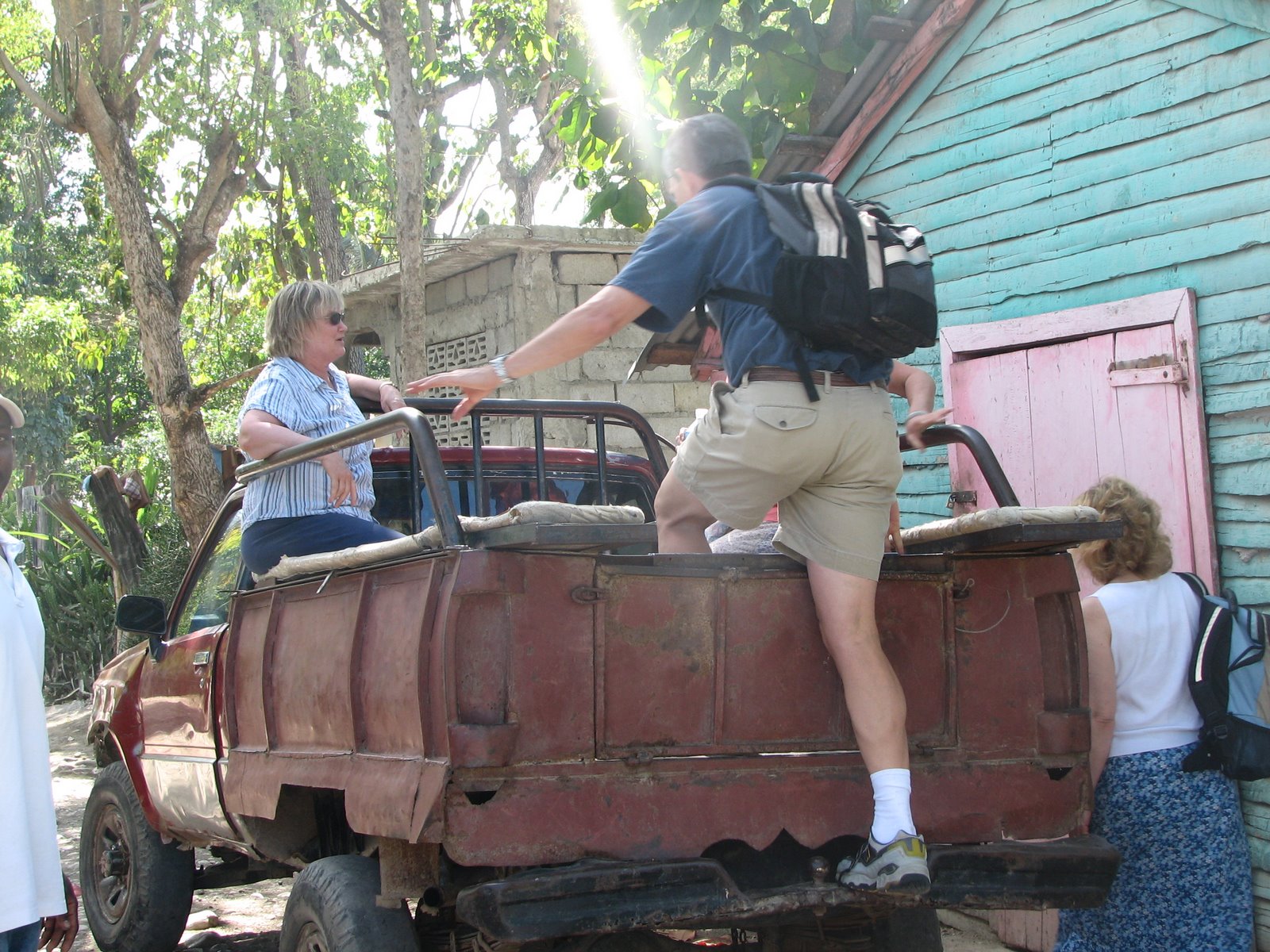
So, Monday morning we packed everything into Ronel’s truck, put on our nice skirts and makeup (except for Steve…for the record, he wore scrubs and no makeup!), and headed for the hospital. At the same time Kathie and Cindy and June headed for a big day of primary care at the Whitney Clinic. When we arrived at the hospital, the classroom was still locked, and Dr.Prince, the hospital administrator, was unreachable, out of town. Fortunately, the Ministry of Health building was open and had a room for us, with chairs, tables, and table cloths, all set up!! And gathered at the front of the building were 6 beautiful midwife students, with perfectly braidied hair, bright white blouses, dark skirts, and HUGE smiles. They were so excited it brought me to tears. Nadene and I were almost overwhelmed with excitement! We set up the table with places for each student, books, notebooks, pens, pencils, wheels, and tape measures. The students were invited in, and took places… Danise welcomed them in Creole, and then asked one of the students to open with a prayer , which she plans to do every day, as it is traditional here. Magdala, Pastor Jude’s wife, started the hymn “How Great Thou Art” , in Creole, and all the students joined in, loudly, and in harmony. With the acoustics echoing inside these cement walls, it was utterly angelic. Nadene and I both sang along (although we were so moved we were crying!) in English.

Danise then introduced the program, and asked each of us to introduce ourselves and speak about why we came here, and the background and philosophy of Midwives for Haiti. Dr.Eads told the students about how it took 2 years to train the first class, due to all the obstacles and changes that occurred during that time, but that it succeeded through great perseverance and commitment, on the part of all the volunteers, the students, and much support from friends in the US. He then explained that this second class is very important, because it will show that this process can be repeated, and become a truly viable established program . Nadene talked about saving the lives of mothers and babies in Haiti, and touched on how it is a primary value that the M4H midwives become famous for being highly skilled, and for their kindness and compassion. I spoke about my path from being a direct-entry home birth midwife, to having a large hospital practice, and how the work of a midwife in all settings, in all countries, is very hard work ,requires a love of mothers and babies, but has great rewards…”and I welcome you to this work.” Another new student arrived every 30 minutes through the morning, until there were 9, and 2 more expected for next Monday! We taught chapters 1 and 2 of the Handbook, and went to lunch in the truck, with HUGE rejoicing—the baby was not only out, it was robust and crying (or singing) loudly. Midwives for Haiti, Class #2, had begun.
video